

Here's a question that keeps me up at night as an English teacher: Why do some students improve rapidly while others plateau, even when they spend the same number of hours studying? After a decade of teaching junior high school English in Japan, I've come to believe the answer isn't about talent, textbooks, or even motivation. It's about metacognition — the ability to think about your own thinking and learning processes.
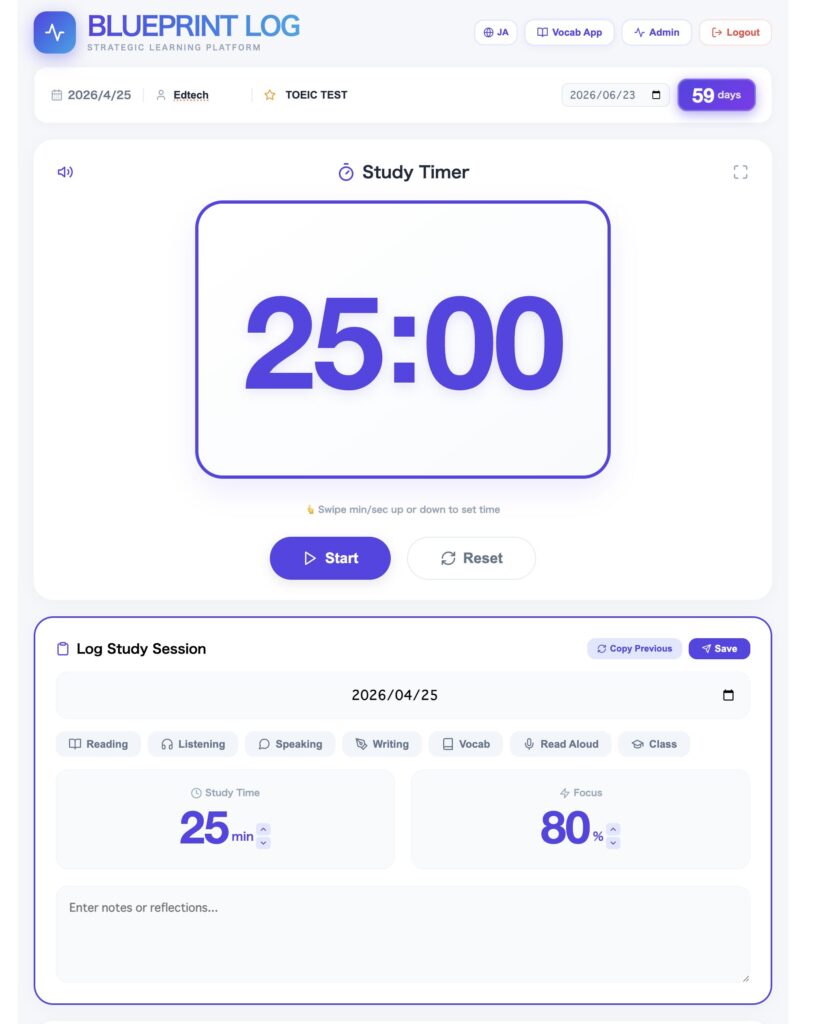
That belief led me to build an English Learning Portfolio app from scratch using React and Firebase. On the surface, it looks like a straightforward study tracker: students log their practice time, pick which skills they worked on, and check a dashboard. But beneath that simplicity lies something far more powerful — a system carefully designed to develop metacognitive awareness and metacognitive control in language learners.
In this post, I want to break down exactly why this app is, in my view, the strongest metacognitive tool available for English learners — not because of flashy AI features or expensive subscriptions, but because it's grounded in how the brain actually learns languages.
1 A Quick Primer: Metacognition in Language Learning
Before diving into features, let's get our terms straight. Metacognition, as defined by John Flavell in his pioneering 1979 work, has two main components that matter enormously for language acquisition:
Metacognitive Knowledge (or Metacognitive Awareness) refers to what learners know about their own learning. This includes understanding your strengths and weaknesses ("I'm decent at reading but terrible at listening"), knowing which strategies work for you ("I remember vocabulary better when I write example sentences"), and recognizing the demands of different tasks ("A presentation requires different preparation than a reading exercise").
Metacognitive Control (or Metacognitive Regulation) refers to how learners manage and direct their learning. This covers three phases: planning ("I'll spend 25 minutes on listening practice today"), monitoring ("My concentration is dropping — I should take a break"), and evaluating ("Looking at my weekly data, I've been neglecting speaking practice").
Why does this matter for language learning?
Research by Oxford (1990), O'Malley & Chamot (1990), and more recently by Vandergrift & Goh (2012) consistently shows that successful language learners use more metacognitive strategies than less successful ones. The correlation is so strong that some researchers argue metacognitive ability is a better predictor of language learning success than aptitude or even motivation.
The problem? Most language learning apps completely ignore metacognition. Duolingo gamifies content delivery. Anki optimizes spaced repetition. Grammarly corrects your writing. These are all useful tools, but none of them help students develop the capacity to think about and regulate their own learning. They keep students in the passenger seat.
The English Learning Portfolio app is designed to put students in the driver's seat. Here's how.
2. Building Metacognitive Awareness: Making the Invisible Visible
The first challenge in developing metacognition is that learning is invisible. Students can't see what's happening in their brains. They often have wildly inaccurate beliefs about how much they study, what they're good at, and whether they're improving. The Portfolio app attacks this problem from multiple angles.
2.1 The Seven-Skill Category System
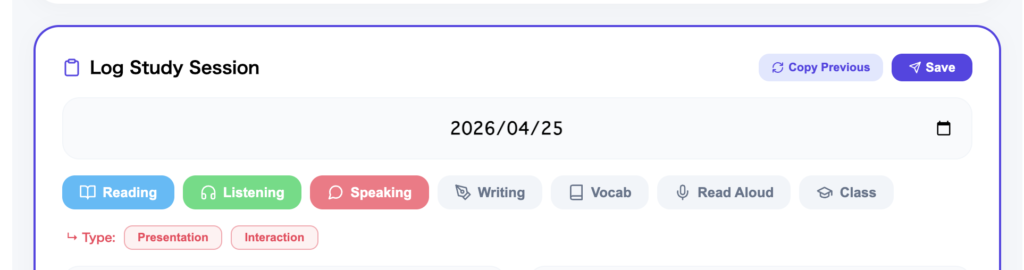
When students log a study session, they don't just record "English practice." They choose from seven specific skill categories: Reading, Listening, Speaking (with sub-types: Presentation and Interaction), Writing, Vocabulary, Reading Aloud, and Class. Each category has its own color and icon.
This seemingly simple design choice has profound metacognitive implications. By forcing students to categorize their practice, the app builds what Wenden (1998) calls "person knowledge" — awareness of oneself as a learner. Over time, students start to internalize the multi-dimensional nature of language competence. They stop thinking of English as a single monolithic skill and begin understanding it as a constellation of interconnected abilities.
I've seen this shift happen in my own classes. Students who previously described their English ability as simply "bad" start saying things like "I'm okay at reading, but I need more speaking practice." That shift from a fixed self-assessment to a differentiated, actionable self-assessment is metacognitive awareness in action.
2.2 The Focus Quality Slider
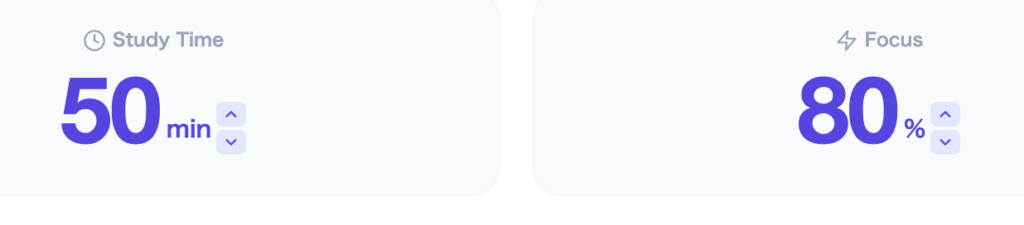
Every time students log a session, they encounter a slider that asks them to rate their concentration level from 0 to 100%. This is a deliberate metacognitive prompt — it forces students to reflect on the quality of their study, not just the quantity.
This feature addresses a common trap in language learning: equating time spent with learning achieved. A student who logs 60 minutes of "studying" while scrolling their phone between flashcards hasn't actually practiced for 60 minutes. The focus quality slider makes students honest with themselves about this. It develops what Schraw and Dennison (1994) call "monitoring" skills — the ability to assess one's ongoing cognitive performance.
Over weeks, students can see patterns in their own data. Maybe they notice their focus is always higher in the morning. Maybe they realize their concentration drops after 30 minutes. These insights are goldmines for self-regulation, and they emerge naturally from the data students themselves have collected.
2.3 The Reflection Field

Each log entry includes a text field for reflections, prompting students with "学習内容や気づきを入力..." (Enter your study content and observations). This isn't a mandatory essay — it's a gentle nudge toward reflective practice.
Research on reflective journals in language learning (e.g., Matsumoto, 1996; Porto, 2007) consistently shows that the act of writing about one's learning deepens metacognitive awareness. The Portfolio app builds this practice into the daily logging habit. Students don't have to maintain a separate journal — reflection is woven into the existing workflow.
What makes this particularly effective is its positioning. The reflection prompt appears after the student has already selected their skill categories and rated their focus — by the time they reach the reflection field, they're already in a metacognitive mindset. The app scaffolds their thinking process.
3. Enabling Metacognitive Control: The Three Phases
If metacognitive awareness is about knowing, metacognitive control is about doing. It's the executive function of learning — planning what to study, monitoring how it's going, and evaluating the results. The Portfolio app supports all three phases through carefully integrated features.
3.1 Planning: Setting the Stage for Effective Study
- Customizable Study Timer
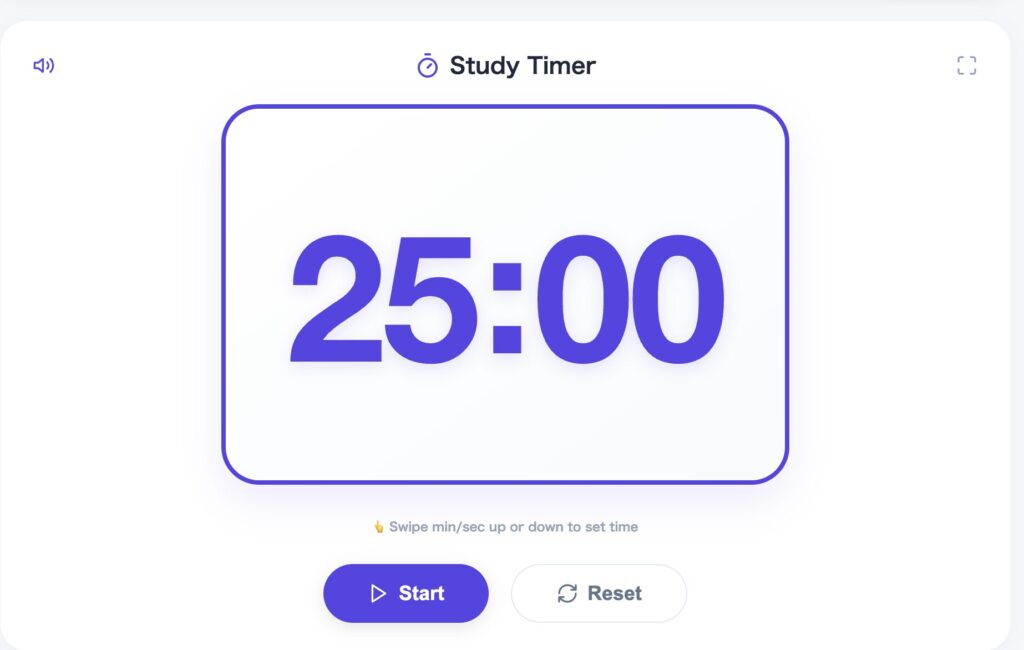
The Pomodoro-style timer (default: 25 minutes) lets students set intentional study durations. The drag-to-adjust interface makes planning feel tangible and deliberate.
- Skill Selection Before Study
Choosing skill categories upfront forces students to make a conscious decision about what to practice, rather than drifting aimlessly through materials.
- Goal Setting with Countdown
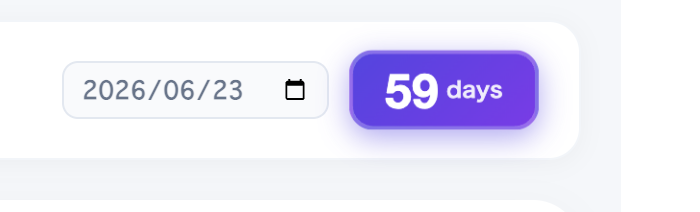
Students set target dates for exams (Eiken, custom tests) and see a live countdown with color-coded urgency — red for ≤7 days, yellow for ≤30 days.
- Copy Previous Session
The "Copy Previous" button lets students replicate a successful study plan, encouraging deliberate routine-building rather than random practice.
The planning phase is where most learners fail. Without intentional planning, study sessions devolve into whatever feels easiest or most comfortable — usually passive review of material students already know. The Portfolio app makes planning the default behavior. You can't log a session without first deciding what skills you're going to work on and how long you'll practice. Planning isn't an add-on; it's the entry point.
The exam countdown feature deserves special attention. By making the deadline visually prominent with pulsing badges and urgency colors, the app creates what Dörnyei (2001) calls "goal salience" — the constant, low-level awareness that keeps students oriented toward their objectives. This isn't about creating anxiety; it's about maintaining purposeful direction. Every time a student opens the app and sees "47 days until Eiken," they're reminded to align today's study with their larger goal.
3.2 Monitoring: Real-Time Awareness During Study

Monitoring — tracking your cognitive performance as it happens — is arguably the most difficult metacognitive skill to develop. It requires what psychologists call "dual processing": engaging in a task while simultaneously observing yourself doing it. The Portfolio app provides several scaffolds for this.
The live timer with browser tab updates keeps study duration visible at all times. Even when students switch to another tab to watch a YouTube lesson or read an article, the countdown appears in their browser tab title (e.g., "(17:32) BLUEPRINT LOG"). This constant visibility serves as an external monitoring aid — a physical reminder that they are in a study session and the clock is running.
The lap recording feature takes monitoring a step further. Students can press a lap button during their study session to mark transitions between activities. This encourages what Winne and Hadwin (1998) call "calibration" — the ongoing comparison between planned and actual study behavior. Did you spend the time you intended on each activity, or did you get sidetracked?
The screen wake lock is a subtle but important design choice. By preventing the device from sleeping during timed sessions, the app maintains the study environment. It's a small metacognitive support — students don't lose their focus context to a locked screen, and they don't have to make the micro-decision to unlock and re-engage.
A key design
3.3 Evaluating: Making Sense of the Data
This is where the Portfolio app truly shines. The Dashboard provides multi-layered evaluation tools that transform raw study data into actionable metacognitive insights.
Four timeframe views — Day, Week, Month, and Year — allow students to evaluate their learning at different granularities. Daily views help with immediate reflection ("Did I study what I planned today?"). Weekly views reveal patterns ("I always skip speaking practice on weekdays"). Monthly views show trends ("My total hours are increasing"). Yearly views provide the big picture ("I've studied 340 hours this year across all seven skills").
Skill breakdown charts with color-coded stacked bars make skill distribution immediately visible. A student who thinks they're studying "a balanced mix" might discover that 70% of their time goes to vocabulary and reading, while speaking and writing get almost nothing. This kind of objective feedback corrects the metacognitive biases that learners naturally develop.
Streak tracking with a flame badge provides a simple but powerful evaluation metric: consistency. Research on distributed practice (Cepeda et al., 2006) shows that regular, spaced study sessions produce far better retention than cramming. The streak counter makes consistency visible and valued.
Notice how the app creates a complete metacognitive control loop. Each study session begins with planning (timer setup + skill selection), proceeds through execution with monitoring support (live timer + laps), includes immediate reflection (focus rating + reflection text), and feeds into longer-term evaluation (dashboard analytics). The evaluation data then informs the next planning phase, completing the cycle.
This isn't accidental. It mirrors the self-regulated learning model proposed by Zimmerman (2002), which describes learning as a cyclical process of forethought, performance, and self-reflection. The Portfolio app externalizes this cycle into a digital tool, making abstract self-regulation skills concrete and habitual.
4. The Language Learning Dimension: Why This Matters for English Specifically
You might wonder: couldn't any study tracker do what I've described? Why is this app specifically powerful for language learning? The answer lies in how the app's design intersects with specific challenges in second language acquisition (SLA).
4.1 Addressing the Skill Imbalance Proble
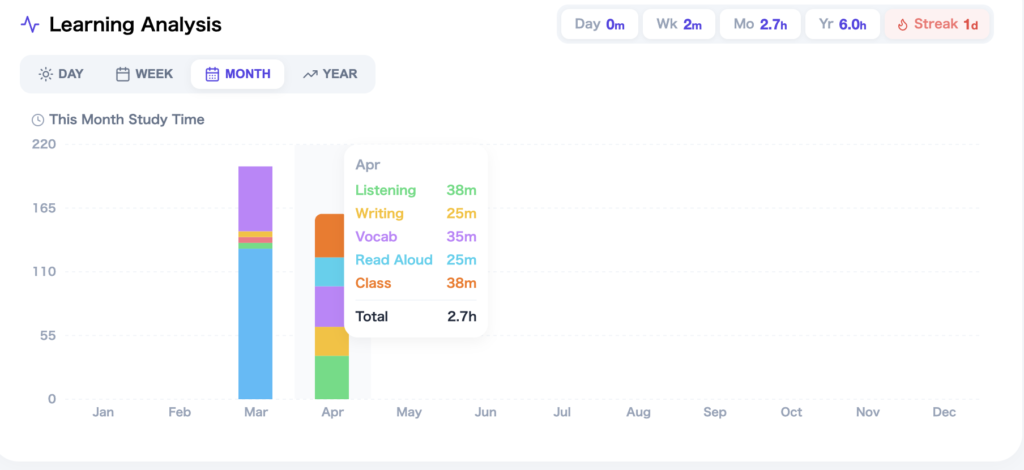
One of the most persistent problems in English education — especially in Japan — is skill imbalance. Students spend enormous amounts of time on reading and grammar but almost none on speaking and listening. This isn't because they don't know speaking is important; it's because they lack metacognitive awareness of their own practice distribution.
The Portfolio app's color-coded skill breakdown makes this imbalance impossible to ignore. When a student opens their monthly dashboard and sees a wall of blue (Reading) and purple (Vocabulary) with almost no red (Speaking) or green (Listening), the data speaks for itself. No lecture from a teacher could be as persuasive as a student's own data showing their practice is lopsided.
4.2 Supporting the Four Strands
Paul Nation's (2007) influential "Four Strands" framework argues that effective language learning programs should balance four elements: meaning-focused input, meaning-focused output, language-focused learning, and fluency development. The seven skill categories in the Portfolio app map naturally onto these strands:
By making these strands visible in the dashboard, the app helps students and teachers evaluate whether their learning program is balanced according to established SLA principles — without anyone needing to explicitly teach those principles.
4.3 The Vocabulary Count Feature
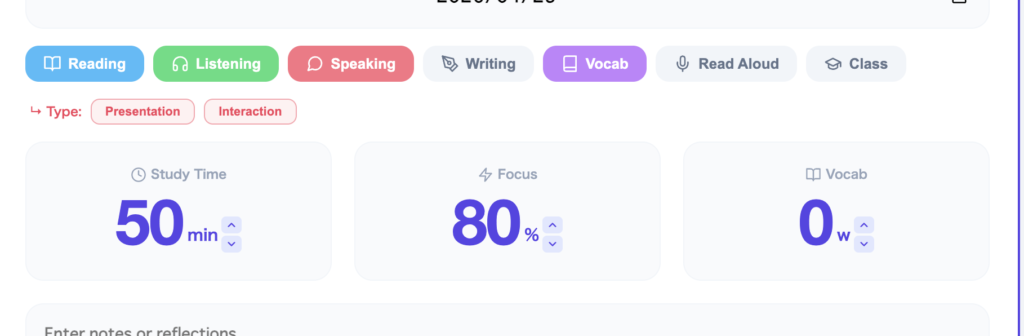
When students select the Vocabulary category, a special counter appears allowing them to log how many words they studied. Over time, this creates a cumulative vocabulary count — a running tally that connects individual study sessions to long-term vocabulary growth.
This is metacognitively significant because vocabulary acquisition is one of the few areas of language learning where progress can be quantified relatively cleanly. Nation (2006) estimates that learners need approximately 8,000-9,000 word families for comfortable reading comprehension. By tracking their vocabulary input, students can connect daily effort to long-term benchmarks, making abstract goals concrete.
4.4 Speaking Sub-Categories
The app distinguishes between two types of speaking practice: Presentation (発表) and Interaction (やり取り). This distinction mirrors the CEFR's separation of spoken production and spoken interaction — two fundamentally different competencies that require different strategies and practice methods.
By making this distinction in the logging interface, the app teaches students to think about speaking practice with more nuance. A student preparing for a speech competition needs presentation practice. A student who freezes in conversation needs interaction practice. These are different problems requiring different strategies, and the app's category system makes that difference explicit.
5. The Teacher's Metacognitive Toolkit
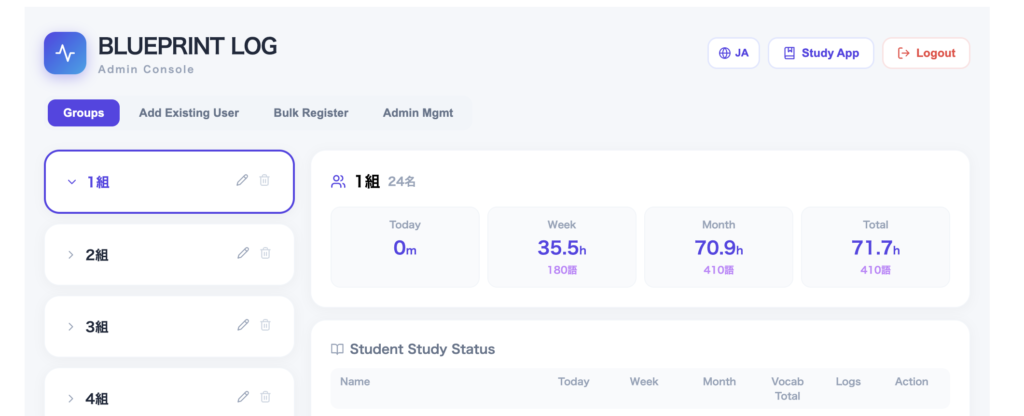
Metacognition doesn't develop in isolation. Teachers play a crucial role as metacognitive coaches — modeling reflective thinking, providing feedback on learning strategies, and creating environments where self-regulation is valued. The Portfolio app's Admin Panel gives teachers powerful tools for this role.
5.1 The Student Monitoring Dashboard
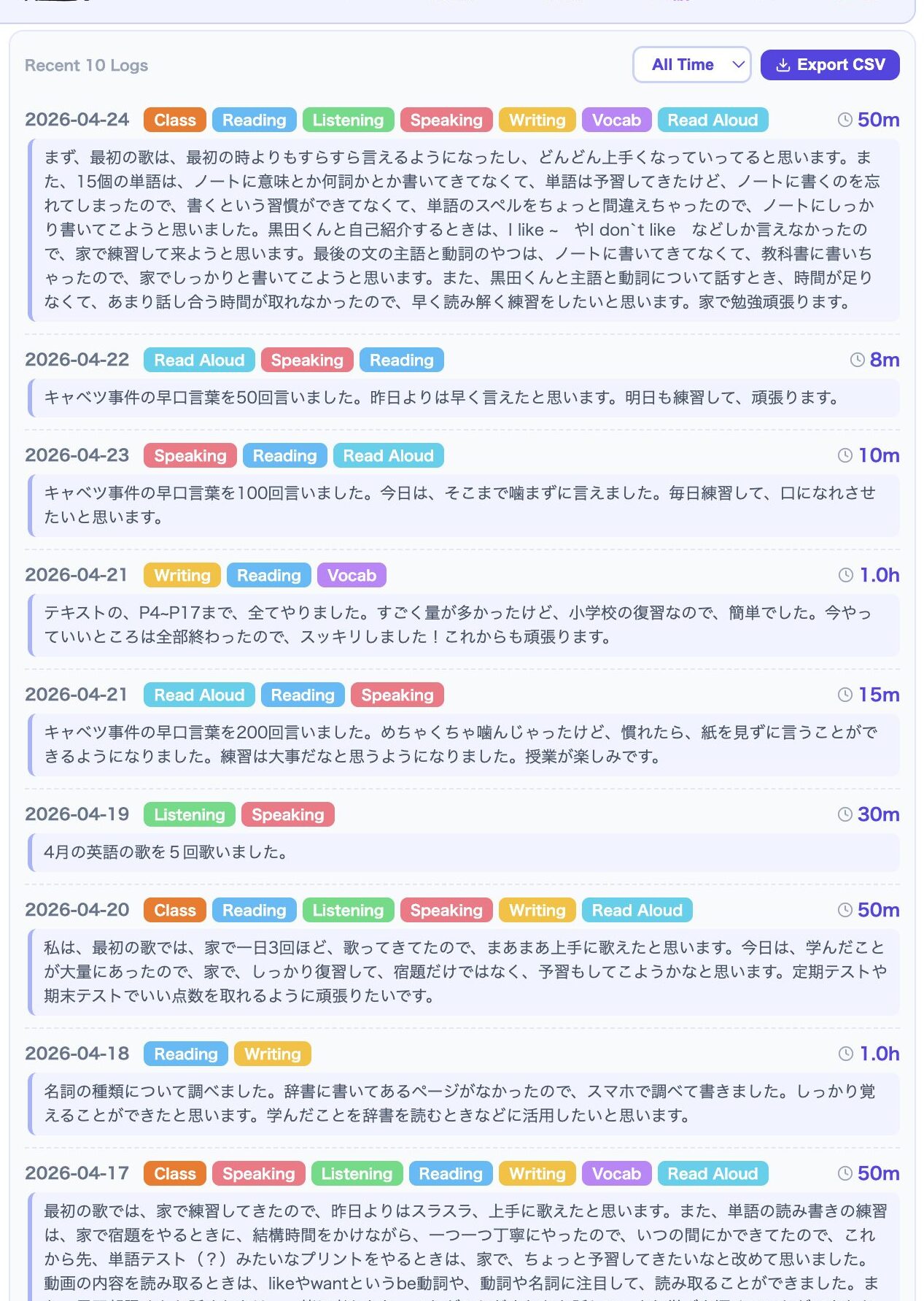
Teachers can view individual student data including today's minutes, weekly totals, monthly totals, vocabulary accumulation, and recent log entries. This isn't surveillance — it's the data teachers need to have informed metacognitive conversations with students.
Instead of asking "Are you studying enough?" (a question that invites dishonesty), a teacher can say "I notice you logged 45 minutes of reading this week but no listening practice. What's your plan for balancing that?" This shifts the conversation from compliance to strategy — from behavior management to metacognitive coaching.
5.2 Group-Level Analytics
The group overview feature lets teachers see class-wide patterns. If an entire class is neglecting writing practice, that's a signal to adjust instruction. If certain students have broken their streaks, that's a cue for a supportive check-in. The data enables what Hattie (2009) calls "visible learning" — making learning processes transparent to both teachers and students.
5.3 CSV Export for Deeper Analysis
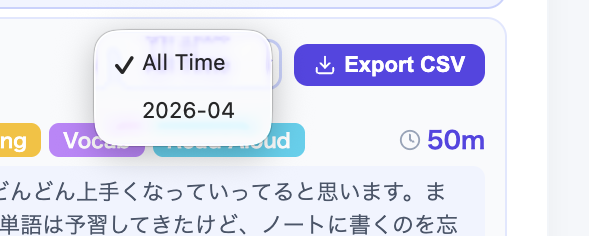
Teachers can export student data to CSV for further analysis in Excel or Google Sheets. This opens up possibilities for more sophisticated metacognitive feedback: trend analyses, comparative charts, correlation studies between focus quality and outcomes. The data is there; teachers can shape it into whatever feedback format serves their students best.
6. Gamification That Serves Metacognition (Not the Other Way Around)
Many learning apps use gamification to keep users coming back. Points, badges, streaks, and leaderboards create dopamine loops that sustain engagement. But there's a dark side: when gamification becomes the point, learners optimize for rewards rather than learning. They game the system instead of developing genuine competence.
The Portfolio app takes a fundamentally different approach. Its gamification elements — the streak counter, confetti celebrations, praise messages, and progress visualizations — are designed to reinforce metacognitive behaviors, not replace them.
Consider the streak counter. It doesn't reward minutes studied or skills completed. It rewards consistency — the metacognitive behavior of showing up every day and engaging with the learning process. A student who logs 10 minutes of focused listening practice gets the same streak credit as one who logs two hours. The incentive is directed at the habit, not the quantity.
The confetti celebration triggers when a student saves a log entry — that is, when they complete the full metacognitive cycle of timing their study, selecting skills, rating their focus, and writing a reflection. The reward is attached to the reflective process, not to correct answers or completed lessons. This is a subtle but crucial difference: the app gamifies self-regulation itself.
"The best gamification doesn't make learning feel like a game. It makes the process of managing your own learning feel rewarding."
7. What Makes This Different from Other Apps
Let me be direct about what sets this Portfolio app apart from the landscape of language learning tools.
The fundamental philosophical difference is this: most language learning apps try to teach English to students. The Portfolio app tries to teach students how to teach themselves English. It's a meta-tool — a tool for becoming a better learner, which happens to be organized around English language skills.
8. The Research Case: Why This Approach Works
I don't want to claim this app is "the best" without acknowledging the research that supports its design principles. Here's a brief tour of the evidence.
Metacognition and language proficiency. Purpura (1997) found that metacognitive strategy use had a significant positive effect on second language test performance, operating partly through its influence on cognitive strategy use. In other words, metacognition doesn't just help students learn — it helps them use their other learning strategies more effectively.
Self-regulated learning and achievement. Zimmerman and Schunk (2011) demonstrated across multiple studies that self-regulated learners consistently outperform their peers, and that self-regulation can be taught through scaffolded practice. The Portfolio app provides exactly this kind of scaffolding.
Learning logs and metacognitive development. Matsumoto (1996) showed that learners who maintained learning logs developed significantly more metacognitive awareness than those who didn't. The Portfolio app digitizes and enhances the learning log concept, adding structure (categories, focus ratings) that paper journals lack.
Visual feedback and self-regulation. Butler and Winne (1995) argued that internal feedback — the learner's comparison of actual performance against standards — is the engine of self-regulation. The Portfolio app's dashboard provides external representations of this internal feedback, making the comparison process explicit and data-driven.
Distributed practice. The streak system encourages daily study, which aligns with decades of research showing that distributed practice produces superior long-term retention compared to massed practice (Cepeda et al., 2006). The app doesn't just tell students to study regularly — it makes regularity visible and rewarding.
9. Practical Implementation: How I Use This in My Classroom
Theory is great, but you're probably wondering: does this actually work in a real classroom? Here's how I implement the Portfolio app with my junior high school students.
Onboarding (Week 1): I create student accounts in bulk using the Admin Panel's CSV import feature. Students get their credentials and spend one class period setting up their profiles, setting an exam goal, and doing a practice log. I walk them through each element, explicitly naming the metacognitive skills involved: "When you choose your skill categories, you're making a plan. When you rate your focus, you're monitoring yourself."
Daily use: Students log their English study at home. It takes about 60 seconds. Some students start with minimal reflections ("I studied vocab"), but over weeks, their reflections become richer ("I tried reading a news article without a dictionary and understood about 60% — I need to focus more on guessing meaning from context").
Weekly check-ins: Every Monday, I spend five minutes having students look at their weekly dashboard. I ask three questions: "Was your practice balanced across skills?" "Was your focus quality consistent?" "What's your plan for this week?" These questions map directly onto the evaluation and planning phases of metacognitive control.
Monthly conferences: Once a month, I pull individual student data and have brief one-on-one conversations about learning patterns. These conversations are transformative. Students who thought they were studying "a lot" see that they've averaged 12 minutes per day. Students who thought they were "bad at English" see that they've actually improved their consistency dramatically. Data replaces vague feelings with specific, actionable insights.
10. Design Decisions That Support Metacognition
I want to highlight a few design choices that might seem minor but have significant metacognitive impact.
Bilingual interface (Japanese/English). The app supports both languages, allowing students to interact with it in their L1 or L2. This reduces cognitive load during the logging process — students shouldn't have to struggle with the interface language when they're trying to reflect on their learning.
Mobile-first responsive design. Students study on their phones. If the app isn't mobile-friendly, they won't use it. By optimizing for mobile, the app ensures that the metacognitive logging habit fits into students' actual lives, not an idealized classroom scenario.
Real-time sync via Firebase. Students can log from any device and see their data immediately. Teachers see updates in real-time. This eliminates the friction of "I'll log it later" — a promise that rarely gets fulfilled. Metacognitive reflection is most valuable when it happens close to the learning experience, and real-time sync supports that immediacy.
The "Class" category with auto-set 50 minutes. When students select "Class" as a category, the timer automatically sets to 50 minutes (a standard Japanese class period). This small convenience reduces friction for logging in-class learning and ensures that classroom time appears in students' study data alongside homework practice. It creates a complete picture of learning activity.
Conclusion: Teaching Students to Fish
There's an old proverb: "Give someone a fish and they eat for a day. Teach them to fish and they eat for a lifetime." Most language learning apps give students fish — pre-packaged lessons, algorithmically selected flashcards, auto-graded exercises. These have their place.
But the English Learning Portfolio app teaches students to fish. It develops the metacognitive awareness and control that learners need to manage their own language acquisition journey — not just while they're in school, but for the rest of their lives.
When a student can look at their own data, identify a skill gap, plan a study session to address it, monitor their focus during practice, reflect on what they learned, and evaluate their progress over time — that student doesn't need an app to tell them what to study next. They've become their own best teacher.
And that, I believe, is the ultimate goal of any educational tool: to make itself unnecessary.
Free & Open for Educators
Master English.
Build Your Portfolio.
The only English learning app designed around metacognition research. Students plan, monitor, reflect, and evaluate their own learning — building the self-regulation skills that drive lasting fluency.
No credit card required. Works on any device.
References
Butler, D. L., & Winne, P. H. (1995). Feedback and self-regulated learning: A theoretical synthesis. Review of Educational Research, 65(3), 245–281.
Cepeda, N. J., Pashler, H., Vul, E., Wixted, J. T., & Rohrer, D. (2006). Distributed practice in verbal recall tasks. Review of General Psychology, 10(4), 354–380.
Dörnyei, Z. (2001). Motivational strategies in the language classroom. Cambridge University Press.
Flavell, J. H. (1979). Metacognition and cognitive monitoring. American Psychologist, 34(10), 906–911.
Hattie, J. (2009). Visible learning. Routledge.
Matsumoto, K. (1996). Helping L2 learners reflect on classroom learning. ELT Journal, 50(2), 143–149.
Nation, I. S. P. (2006). How large a vocabulary is needed for reading and listening? Canadian Modern Language Review, 63(1), 59–82.
Nation, I. S. P. (2007). The four strands. Innovation in Language Learning and Teaching, 1(1), 2–13.
O'Malley, J. M., & Chamot, A. U. (1990). Learning strategies in second language acquisition. Cambridge University Press.
Oxford, R. (1990). Language learning strategies: What every teacher should know. Heinle & Heinle.
Porto, M. (2007). Learning diaries in the English as a foreign language classroom. ELT Journal, 61(4), 335–343.
Purpura, J. E. (1997). An analysis of the relationships between test takers' cognitive and metacognitive strategy use and second language test performance. Language Learning, 47(2), 289–325.
Schraw, G., & Dennison, R. S. (1994). Assessing metacognitive awareness. Contemporary Educational Psychology, 19(4), 460–475.
Sweller, J. (1988). Cognitive load during problem solving. Cognitive Science, 12(2), 257–285.
Vandergrift, L., & Goh, C. C. M. (2012). Teaching and learning second language listening: Metacognition in action. Routledge.
Wenden, A. L. (1998). Metacognitive knowledge and language learning. Applied Linguistics, 19(4), 515–537.
Winne, P. H., & Hadwin, A. F. (1998). Studying as self-regulated learning. In D. J. Hacker, J. Dunlosky, & A. C. Graesser (Eds.), Metacognition in educational theory and practice (pp. 277–304). Erlbaum.
Zimmerman, B. J. (2002). Becoming a self-regulated learner: An overview. Theory into Practice, 41(2), 64–70.
Zimmerman, B. J., & Schunk, D. H. (2011). Handbook of self-regulation of learning and performance. Routledge.